

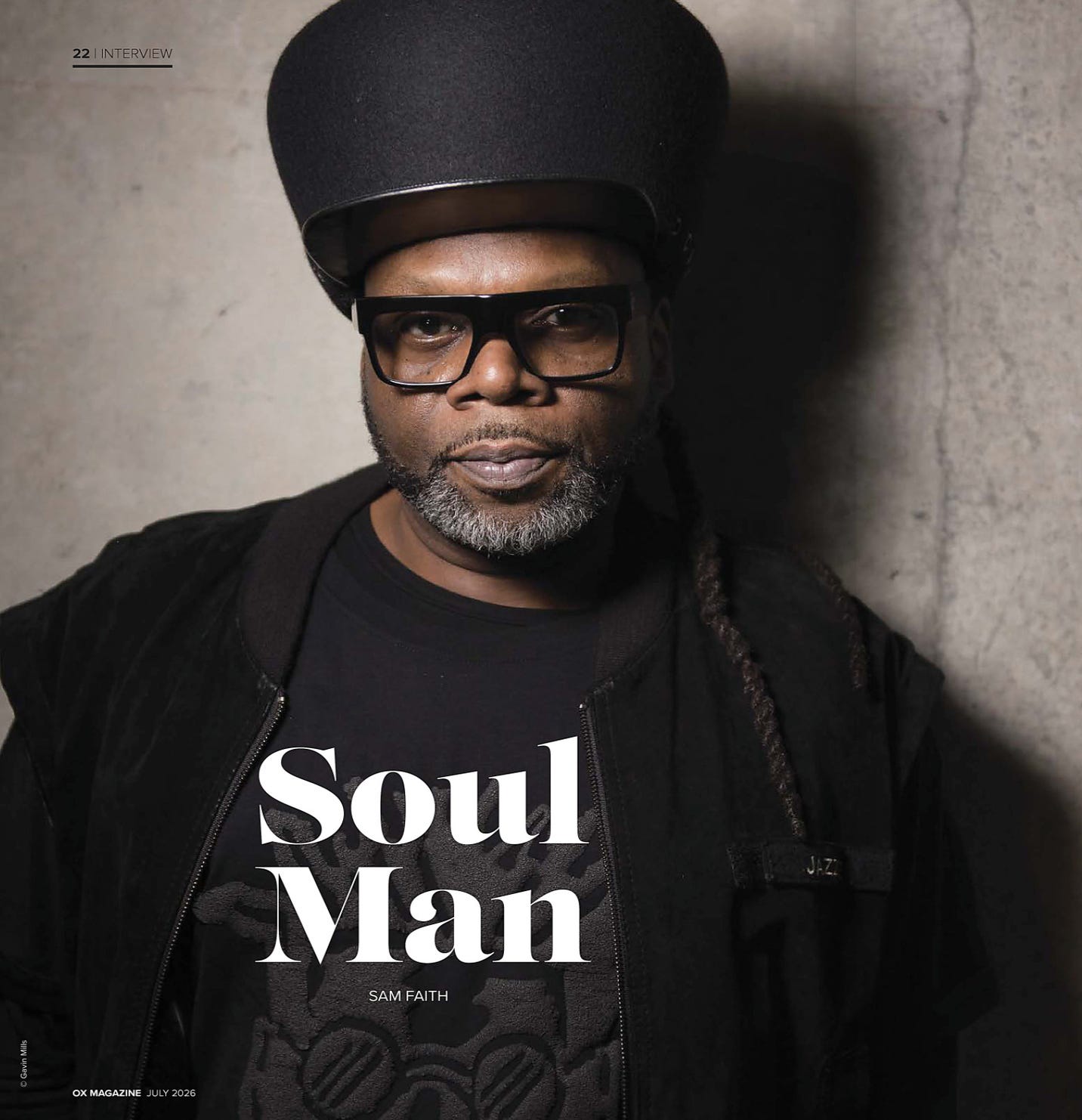
You know the week will be a banger when your glorious editor-in-chief gets you to interview Jazzie B. Yes, he of Soul II Soul – the Funki Dread himself.
Born Trevor Beresford Roman in 1963 to Antiguan parents, Jazzie B grew up in a large North London family steeped in music, community and storytelling. He had his musical roots in the sound systems of the 70s – groups of DJs, musicians and engineers who created music for large PA system events. First gigging as Jah Rico, he soon went on to create Soul II Soul and became one of the defining figures of 80s British music, creating classics such as ‘Back to Life’ and “Keep On Movin’”, while championing a spirit of inclusion summed up in his famous mantra; ‘a happy face, a thumping bass, for a loving race’. He’s recorded an impressive five studio and two live albums, with Soul II Soul’s debut achieving massive global success and multi-platinum sales.
As a producer, Jazzie B has worked with James Brown, Kym Mazelle, Nas and Destiny’s Child, to name a few. He’s had numerous accolades, most notably perhaps being listed as first for business among 100 great Black Britons, receiving an Ivor Novello award and an OBE.
My interview with Jazzie B went to places I didn’t expect and, throughout, I found him relaxed and friendly; a curiously self-effacing man less interested in fame and way more dedicated to an idea of community with a keen interest in history…
What shaped your early musical influences?
I was born into a big family and we were a Christian household. However, everything from Engelbert Humperdinck to Lou Rawls and the World Service was played in our house. A lot of reggae music with a constant tone of country and western too. Story-led music. My idea of melodies and lyrics was stamped right there by these influences.
You were involved in various sound systems of the 70s – is this what shaped the concept of Soul II Soul?
Looking back, it probably was, but also it was a case of joining the dots. I was born in London growing up with all the unrest of the 70s. Punk attitude played a heavy part in terms of what I believed, because it totally broke all the rules. For me, the concept of Soul II Soul was to become an inclusive sound system. Because there was this whole exclusive ‘trying to find your tribe’ thing going on then, but we were so culturally confused with all the mixed political messages of the times.
In Antigua, for instance, which I visited through BOAC Junior Jet Club, I would get called ‘English’ or just ‘alien’, whilst back home on the Holloway Road, I got told to go back to my own country! It was very confusing. I just wanted a space where all our friends and all our communities could come together, regardless, under the guise of ‘a happy face, a thumping bass for a loving race’ – just express ourselves and have a good time. That’s what it was all about.
Having that experience of being told you don’t belong either in Antigua or back home in London, did you ever feel the need to research your African roots in any way?
On a trip to Los Angeles, I went to see my Auntie Lily, who was an activist; she explained the African American side of the black struggle to me. Later on, Bernie Grant inspired me to dig a bit deeper, and in Antigua I was given access to their slave archives. I traced entries for our family right back to the original slave owners. My people’s African origins were occluded, but I know they were sent to a plantation outside Montpelier (a small village on the eastern side of the island). My mother and father were from a village called Freetown on the map, but it’s called ‘Behind God’s Back’ locally because it’s the furthest point east and remote. It’s the most beautiful side of the island with gorgeous beaches. I’ve a home in Antigua which actually overlooks Montpelier and the fields my people would have worked – my beach is called Half Moon Bay. So it’s funny how things go around. I have been able to peel back the painful layers of our family’s transportation that takes me right back to a source of DNA. My grandmother, aged 14, for instance, married a local overseer, my grandfather, who was three times her age – imagine that. Africa-wise it was difficult to tell with just DNA which tribe, or even what part, you came from, because it simply wasn’t logged in the entries, so that unfortunately is the dead end.
In any case, I’m blessed to know, through my grandmothers’ stories, the other families; my brothers and sisters who came to and left Antigua. I’ve got to travel across the world. The colonial system may have had the idea of keeping our people under control, backed up by religion, but it was flipped on its head. That’s what makes being born and raised in London so very interesting in relation to Soul II Soul’s evolution in the 80s, because there I was, a child of the Windrush generation, yet I carved my way in the same streets and taverns where merchants would have once discussed the tobacco, cotton and slave trade in the 1700s.
That’s the thing about evolution; the same people who would have colonised my forebears ended up giving me an Order of the British Empire! Which I accepted, because I figured, well, if the story’s gonna continue, someone’s got to know what’s going on behind closed doors and you can’t get in the front door unless you’ve got a key!
So, the OBE; I’m curious how you feel towards the monarchy and imperialistic structures like that – you said you have to be on the inside in order to effect change, but it must be conflicting?
The Prince’s Trust funded the recording studio in my building in Camden and Prince Charles came to see what the trust had set up for us. Years later, he’s presenting me with an OBE – that was actually pretty cool and now he’s the king.
But yeah, it’s a tricky thing, with my parents having been from the colonies and all the things my brothers and sisters went through there. It’s an interesting argument to have with ignorant people. However, when I look back personally, I do think – wow, because we had a lot of opportunities in the 70s and 80s without realising it, compared to the kids I try to mentor or give advice to today. We could stay after school in clubs if we wanted to – that’s how I built my first sound system with the best technicians in the world. The teachers were there to drive you and influence you – they were really invested in their pupils.
You talk about mentoring kids now? Are you involved in an organisation?
The Peel Community Centre runs one of the programmes I’m involved in around mental health, and there’s the local festival I do every year in Camden with Nikko Culture – The Back to Life Café at Hawley Wharf – it’s absolutely free for the whole community.
Have you found your musical taste changing? What new influences are coming into your sphere now?
Life is forever changing and forever evolving. I’m listening to Shy One at the minute. She has a new album, ‘Mali’,, which is pretty incredible. Just today I’ve been with a duo called Sigma, who have done a drum and bass remix of ‘Back to Life’ – I’ve been filming with them here in Camden. I still buy records. I love music. I’m constantly inspired by people who have put their time in. Things have changed in the music industry, that’s for sure – everything is merging and it’s nice to still be part of that journey; it’s nice to be asked.
The game’s changing, especially with the big corporates and promoters; that’s why integrity is important; we’ve got to understand the influences that can lead to other great things. We’ve got to find a way of nurturing talent. We have to find a way of being able to help new artists produce music and push innovative, creative ideas back out there.
Our chat went by too fast – there was so much more I could have asked this charming, erudite man. One thing that struck me above all, though, is that at 62, Jazzie B remains as interested in the future as the past. History matters, but so do community and forging future musical legacies. For a man whose career was built on bringing people together, nurturing the next generation may be his most important project of all.