

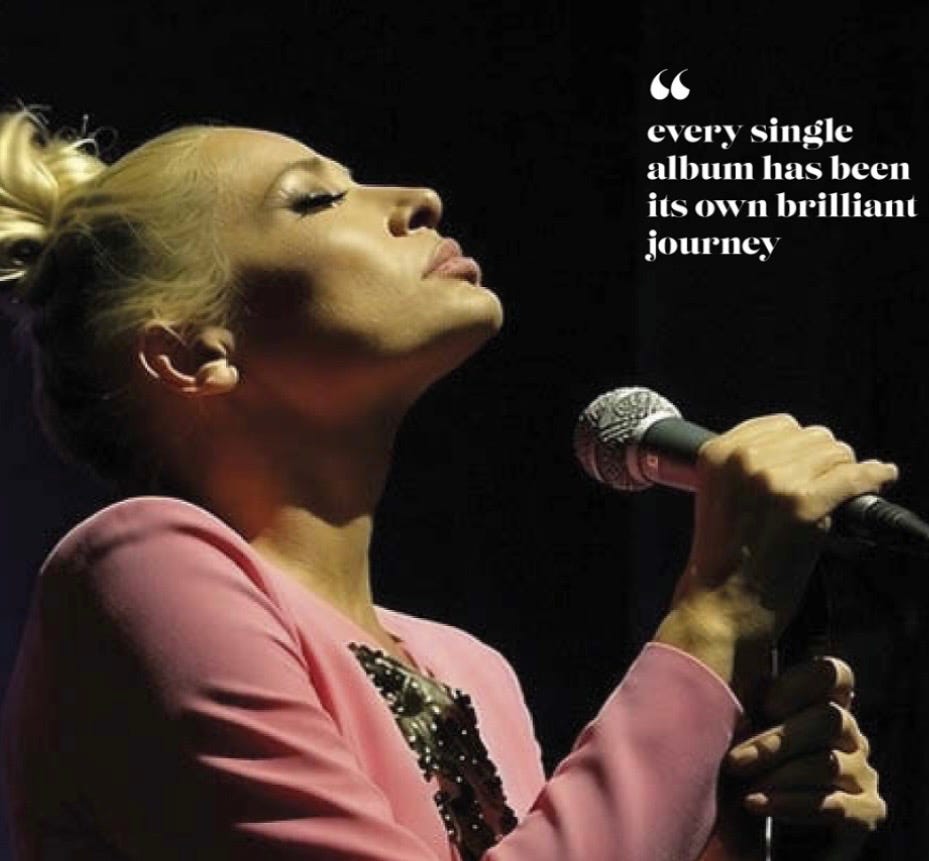
Wendy James: Bit of a Mensch with a Rebel Heart
Interview by Sam Faith
I remember seeing Transvision Vamp on the telly. Singer Wendy James was bubble-gum cute with her blonde hair and elfin face. Then she let out a rock scream which rivalled Joan Jett’s. I took notice. On closer inspectio
n, with the tousled hair and Billy Idol sneer, she had an edge to her. A kind of British Debbie Harry.
Indeed, as she belted out ‘I Want Your Love’, I heard echoes of Blondie’s ‘Picture This’, with its reverse gaze of a woman staring at her male lover. For I too was a small blonde woman, disregarded as decorative before I opened my mouth, so it struck a chord. She had her own agenda and didn’t care who knew it.
So I was looking forward to interviewing Wendy James. There was much written about Wendy back in the day. Salacious at first and then downright abusive, typical of the way British tabloids treated many women at the time. Talking to her, she sets right any misconceptions without fuss, displaying the intelligence, resilience and drive that still motivate her.
When we spoke, Wendy was preparing to tour as Transvision Vamp without Nick Sayer, the other founding member. I sensed no love lost, but Wendy was uninterested in dwelling on that, as she spoke of the impressive line-up of trusted musicians she had assembled for the tour to give an adoring audience all the heritage hits. She was more eager to tell me of plans to record a new Transvision Vamp album after the tour, adding to her impressive back catalogue with the band and through her own projects, including the Racine albums.
Like Debbie Harry, you were adopted. I find there is a difference in the way adopted people shape their identity. Did you find this in yourself growing up?
Yes – it engendered an incredibly strong survival instinct and because there was nothing to relate back to family-wise, I found I was my own object. So I left home on my 16th birthday and gravitated toward people similar to me and who relate to me. I’d already awoken to the siren call of rock and roll music, and I knew the middle-class background I was raised in just wasn’t for me. I had been spending a lot of time in London going to nightclubs underage. So I was ready for ‘The Big Smoke’, but I went to Brighton first, which always felt temporary, but it was where I wrote the demos with Nick Sayer.
I’d met Nick in a bar with a friend. He had the Suicide album ‘Alan Vega and Martin Rev’ under his arm. He asked if we wanted to go to a house party and gave us some amyl nitrite. We went and listened to the album. He said, ‘I’m looking for a singer’, and I said, ‘I can sing!’ But until then, my singing had been in the school choir and once at Glyndebourne – very middle-class, but I’d started bunking into gigs like the Clash. That’s what really put the fire in me, seeing Joe Strummer. I had no idea how I would get from singing in a school choir to being in a rock band. But I knew that somehow it was gonna be.
When you see your first great band, it affirms that there is an alternative view of the world and changes the compass for the rest of your life, doesn’t it?
That’s the unified experience we all have. When you come into contact with alternative forms of culture and relate to it, you know that you’ve found your home. My life became elevated by Joan Didion, because she’s so observational of herself and situations with such attention to detail, like Hunter Thompson – when they write, they are in the story themselves.
When you had your first ideas of shaping a rock band, how did you see Transvision Vamp as being?
Nick did the majority of the songwriting and the concept was to be like Blondie, glam rock and pop, with the appeal of Marc Bolan. Plus a bit of the Stooges and the Ronettes. I do think we had an edge which was different to any other band fronted by a female in that generation.
I don’t know if I went out of my way to be rebellious, but growing up and becoming successful in that era, there was still a lot of sexism in the media. Confronted with that, I would speak my mind. I remember TV interviews. Frank Bough did one where he was discussing my looks. Then he said, ‘Oh, you’ve got quite a few opinions, haven’t you?’ As if this was strange. It wasn’t as repressed as it was in the ’50s, but there was still a great deal of stereotyping.
Transvision Vamp’s first album came out when you were barely in your 20s? What was that like? And who would you say was your greatest inspiration?
Those days were wild and free. With youth on your side, you fear no danger. My long-term boyfriend Mick Jones (from the Clash) was more of an influence overall, perhaps. Nick (Sayer) was very influential in the beginning because he was 10 years older, knew more about music and owned lots of books. I was surrounded by encyclopaedic male musicians so that if I had a question, they’d know the answer. There weren’t so many females about – I knew Chrissie Hynde a bit. Poly Styrene, Siouxsie Sioux and Debbie Harry did change things too, but musicians are equal opportunity kind of animals – they don’t really care if you’re female or male. They’re just interested in whether you’re any good. My ambition was to be in one of the biggest bands in the world and perform well – nothing has changed from that.
Transvision Vamp had great success, particularly with Velveteen, the second album, but the third album changed things. Was this due to internal struggles or were you dissatisfied with what you were doing?
The struggle was with the UK record label. We had taken on a more American rock sound with the album and our success was growing in America. The UK label decided that we had strayed off course from what they wanted us to deliver, which was more ‘Velveteen’, but we had the best sales ever in America with ‘Little Magnets’ and toured America twice in 1991. However, Nick and I decided those would be our final tours of America, and I was ready to go from Transvision Vamp to being a solo artist.
This brings us to Elvis Costello and the famous letter you wrote to him…
Yes – I was staying at the Sunset Marquis (in LA). I walked into the bar and Pete Thomas, drummer from the Attractions, was there. I said, ‘I think we’re going to end the band. Do you think Elvis would write a song for me?’ And he said, ‘Why don’t you write him a letter?’ That very night I wrote Elvis a letter on Sunset Marquis stationery. I didn’t get a reply, but I heard murmurs from his publishers. By the time I got back to London, there was a whole album on cassette waiting on the doormat of my home.
I got back on a plane to LA, changed record label to Geffen and recorded the album, which was produced by Rolling Stones producer Chris Kimsey.
I had a lovely time recording it, but looking back, it showed me that I very much wanted to write my own music and sing my own lyrics, with my own feelings, thoughts and emotions, rather than someone else’s version of me. So the Elvis album was an accelerator. That’s when I ducked out of the public eye, moved to New York and started writing the songs which would become ‘Racine No. 1’.
What is your favourite album? The one which says what you wanted and that you’re proudest of?
‘I Came Here to Blow Minds’ stands out for me. I recorded it in Paris and mixed it in Sydney. It’s got a really charming mix of indie and power punk. ‘The Shape of History’ opens with a brilliant track. ‘Queen High Straight’ is a double album. Before that, ‘The Price of the Ticket’ had a great line-up, but every single one of those albums has been its own brilliant journey.
Back to the Transvision Vamp tour – what kind of show are you giving the audience?
The tour will be all the hits, songs I consider to be the best from the three albums. We play them authentically with just as much pop aggression – under no circumstances have we mellowed. This is an aggressive band that knows how to play for an hour and 45 minutes.
More information: thewendyjames.com